This & That : Sea Anemones
Business leadership
Some of us work with global businesses where the dominance of self-interest and the ignorance of - or numbing to - the impact of our business decisions, is rife.
“For some years I worked on a large project, where the pressures of getting it ‘right’, the unending focus on costs and time often felt overwhelming. Experimenting with the possibility of opening and closing using the anemone as a model of Nature’s intelligence, and doing this with a few of us, felt supportive and full of camaraderie in trying this out together.
In experimenting like this, I felt opened up to my own naivety of previously resolutely remaining open where there was no possible nourishment on offer, searching for crumbs of tenderness and kindness where these were in short supply with the stresses of the moment, and questioning why I always felt battered and beleaguered(!). By experimenting, I started to trust my body’s sense of when to unfurl and when to withdraw in. In those moments, I felt less knocked off-kilter within and a small but growing steadiness in the face of situations that felt full of pressure.
Another brilliant consequence of sharing with others in our community about living “This” whilst being a part of “That” was that our sharing highlighted my fears, expectations, hierarchy and previously-fixed ideas of how things should be, then helped me dismantle them. This then allowed me to really open up with colleagues and co-workers. I have felt moved again and again by the depth of connection and relationship I feel with other colleagues, in often quite staid workplaces, and the human connections that have formed unexpectedly from what had otherwise felt limited by the environment and my own expectation. I have at times been blown away by what’s unfolded, and am grateful for the chance to experiment, and the possibilities that have opened out from this. Several years later, the team that formed working on this large building project, we’re all still in touch, and a warmth and care feels to move easily between us all still.”
Education
Some of those who met work in academia, where quality standards are understandably key and career progression is individualised. Again, many measures of success focus on the economic activity of our students after graduation. Learning for earning is a well-used term in universities today, when what really sustains our teaching, our student support, our research and innovation activity is our passion for our subject area.
One of our academics and has been teaching and researching in a renowned UK university for more than 20 years, including taking care of the welfare of postgraduate students for over a decade.
What happens when what feels true to us meets the structures, expectations and pressures of working life? This & That explores how we might stay connected to what we value without needing the world around us to change first - with a little unexpected help from the sea anemone.
Some context
Time on yoga retreat with Judith and a group of 15-25 people over three to five days, left everyone feeling rounded out, clear on and aligned with our values and committed to contributing to collective good in our daily lives. However, upon returning home, those of us who work with large organisations or in defined professional fields experienced a challenge on how to live this way in our working day. We noticed that the structures, hierarchies and expectations in our work organisations and professional practice didn’t encourage us to bring our whole selves to our work. We had to fit into a different, narrower shape, sometimes abandoning our values at the office door until home-time. Yet we recognise that those very organisations and professions we work within have a key role in transforming themselves to enable collective good. We felt we wanted to bring the rich experiences from our time on retreat to our workplace, so that we, our colleagues and our organisations could benefit. Judith invited a group of us working in academia, healthcare, business and accountancy to meet to discuss the dissonance we felt and to be curious about ways we could bring our whole selves and all that we truly value to our workplace and professions.
This and That
We started referring to the difference we felt as “This” and “That”. “This” we felt refers to what feels true in one’s own body, taking in information beyond thought and knowledge, allowing tenderness, care and kindness to arise spontaneously, being light-hearted, open to, and nourished by, not knowing, by what we don’t know but feel. Allowing something to arise and flow through us, without putting our name on it. “That” refers to the structures, frameworks, rules and other, mainly man-made, laws we work within. Of course, many of those structures were designed for good reason to safeguard and protect, or to allow consistency and quality. Yet organisational and professional expectations are often reduced to specific and individual measures of success, often related to short-term economic gain. This can limit us living our true selves, our values, accessing and expressing the intelligence of our bodies and from that creating long-term collective good. Rather than living a binary “This” (on retreat) or “That”(at work), we started to ask ourselves how to live “This” whilst being part of “That”.
Learning from the Sea Anemone
Judith, having observed sea anemones at close quarters, suggested we be inspired by them. Sea anemones open when there is nourishment available at high tide - when we feel able to stay true to our feelings and fully express ourselves. We could relate to being this way with our friends and family, or perhaps with a small number of colleagues, and wondered how could we be this way at work? The sea anemones close into what must be a velvety softness, when the tide recedes and there is no external nourishment. We started imagining closing as a way of staying true to ourselves, not denying our body intelligence if we were not able to express it in our workplace or if it fell on deaf ears.
Accounting
Some of those who met were practicing accountants where time equals money, targets must be met and external audit and scrutiny are the norm. Sometimes the professional expectations demand long sedentary hours in front of a screen, short breaks and lack of care for our bodies. Our wellbeing becomes negatively impacted. This may be the same across other professions in the monoculture where economic activity is the measure used in almost all sectors to show success. What would it be like if success was related to health or happiness at work? How could we be sea anemones in the workplace?
“For thirty five years working in an investment bank I often felt a fish out of water, in part fuelled by ideas of being ‘different’ and ‘better than’ others, but mostly feeling that what I cherish and what makes my heart sing, was not a match for my workplace environment, the company’s objectives or the ways they went about achieving them.
Practicing the lessons of the sea anemone, in my later years working in banking, was like using a favourite tool and companion that gave me a broader perspective of the circumstances I found myself in and what I was experiencing. It always left me feeling lighter, able to respond from a different starting point, not charged with emotional reactivity, and with space to breathe, to move and be moved.
The analogy of the sea anemone - opening out its tentacles to draw in nourishment from the sea when the tide comes in, and wrapping its tentacles around its nourished self when the sea is out - helped to loosen how I had been cocooning myself with what and how I wanted the world around me to be. Instead, I was able to acknowledge, see and face how things actually were, especially when circumstances were tough and definitely not nourishing. I was able to bring honesty about my part in that too - instead of deluding myself out of fear and insecurity - I was able to bring clarity about my part with a relief that feels liberating.
Feeling “this” and “that” as a lesson from nature - as a natural part of life and living - disarmed my judgement, objection and upset at finding myself at times in what felt like working with a bucket of snakes and self-interest in a place without communal care.
One of the teachings from Judith which has stayed with me was about transforming my perspective. Instead of me feeling ‘strange’ and uncertain to live “This” in the corporate profit-driven world, I was able to consider that perhaps the corporate world has it all upside down and I was having a perfectly natural response to something that felt not quite right.
One of our accountants worked on a high value building redevelopment project in London.
“Starting my job at the university I had an imagined model of what success is in academia, aspiring to be a leader in my field, driven to achieve impeccable lectures and tutorials, aiming at being responsive and supportive of our students. Nothing wrong with that however, increasingly, I was questioning if my intent was really aligned with my true feelings about being a teacher, a researcher and a carer. Do I really want to be in service to the students? Or do I want to shine in front of them and get a “high” from it? Do I really want to contribute to a greater knowledge in my research area, or am I only interested in getting recognition and feeling superior? Eventually, my body spoke and two years ago I had to take a medical leave of several months, unable to work anymore. I had been “playing the game”, but a game that didn’t include care for my body, because of placing high demands on myself and because of the gap between “This” and “That” so present –but repressed– in my day-to-day life.
In the Sea Anemones meetings I found a space where I could share what I felt of “This” in the workplace, something I had so far separated from my working life. Little by little, the separation is disappearing. I can be fearful of revealing too much of what I file as “not core business”, but I have found myself writing to my colleagues wildly and beautifully about our subject area. Sometimes I can feel “That” creeping in, as I start playing the game again, rather than being in service to what I find beautiful and which moves me deeply in my work. Now, thanks to all that we have engaged in meeting to discuss “This” and “That”, my self-judgement is easing and I do not have a sense that I have failed or that “I’ve lost it” like I used to. There are many little things which help me to reset, for example noticing the flow of the tides on the river Thames or the beauty of a tree I pass on my cycling route to work, or even something as simple as looking at the almost child-like drawings of animals on the ATD front page makes me remember who I really am.”
Business leadership
Some of us work with global businesses where the dominance of self-interest and the ignorance of - or numbing to - the impact of our business decisions, is rife.
“I remember the repeated experience of coming off a retreat and going back to work and feeling something painfully constricted in me and defaulting to a hardened version of myself. I’d left a big global consultancy for a boutique consultancy, eventually not being able to bear what felt like a relentless competitiveness and focus on chargeable hours. For most of my early career I numbed to my discomfort, believing this was ‘normal’, and to be pushed through. Believing this is what it took to be successful, to have a good job, to prosper in the world, to have status. I denied what I felt because it felt too painful.
Being part of This & That helped calm something in me. I still work in big, for-profit organisations, on occasions I still numb to the true costs of the self-interested profit motive, though less and less, and at times I harden and go judgmental and superior. At times I feel hopeless. This & That, however, has helped me increasingly to interrupt these patterns. Helping me be to honest with myself.
I’m aware of my choice to be present to the reality of ‘what is’. In accepting that, I’m able to start from a different place. Working with people in different organisations, I feel more present to who they are, to what they are feeling, and what they value. I listen in ways I never used to, allowing space for, and valuing, ‘not knowing’.
This & That has also helped me loosen my fear of ‘lack’. As a small consultancy it’s easy to feel vulnerable to not getting enough business to survive, and the time running the business, the weight of that responsibility could feel overwhelming. Loosening that fear, the fear of failing to provide for my family, failing to uphold the lifestyle I’ve worked hard for, losing my markers of ‘success’, failing… period, has been so fundamental for me. I’ve learned to feel, truly, I’m not alone, that my compulsion only to rely on myself is deeply misplaced, that I am part of something so much bigger – the flow of life, everything and everyone else. This & That has helped me feel my trust in that because I can feel it. And I feel how it allows me a fundamentally different starting point – to be in service of something that feels deeply worthwhile, to care. That’s more than just me.
Inviting a colleague of mine to a recent All Togetherly Different event, they remarked that they felt a level of openness and honesty amongst us that they had never experienced before. An experience they said they really treasure. I feel the same. And every opportunity I have to experience it feels a new experience, fresh and enlivening.”
The Beadlet Anemone (actinia equina) is common in tidal zones around the UK coast. The base of its body acts as a sucker, securing it to rocks. When the tide goes out, it closes its short tentacles, sealing the mouth to avoid dehydration, and looking when exposed to air like a blob of jelly. Beadlet anemones feed when the waters return. They are impressively adapted to tolerate hot, dry conditions when the water recedes.
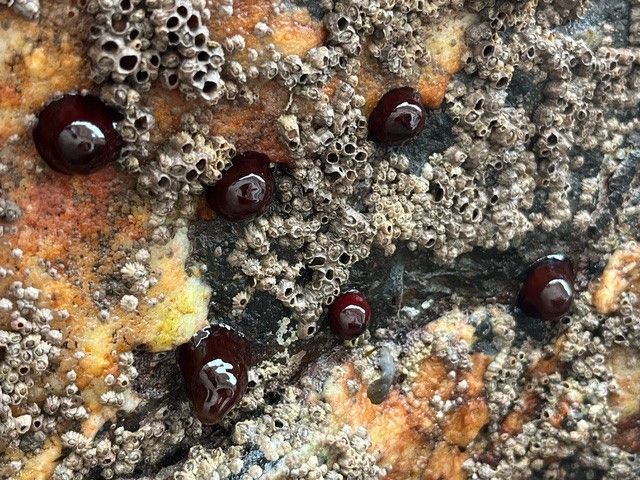
Picture by Judith Seelig
These anemones feed by stinging passing prey, which includes crab, shrimp and small fish. They are aggressively territorial, fighting off possible incursion from other anemones. Our photograph shows them clustered on the underside of a rock, which obviously offers maximum protection from sunlight. We only use the protective aspect of the anemone sealing itself in a non-nutritious environment, and opening up when the waters return, as a lesson from Nature. We note they are often to be found in clusters on prime sites. We are not suggesting any of us will gain from following their example in stinging fellow anemones and causing them to fall off in defence of an individual’s anchorage.
©Judith Seelig 2026